
Pakistan Airports Authority
- A cargo plane went missing near Pakistan on Tuesday but was found after a 12-hour search.
- Flight data shows that the plane rapidly descended before losing contact with air traffic control.
- Aviation experts say there are many possible explanations for the crash, but information is limited.
The wreckage of a Boeing 737 freighter that plummeted from 35,000 feet into the Arabian Sea on Tuesday has been found after a 12-hour search-and-rescue effort, and theories about what caused the crash are circulating.
Until the debris and the black boxes, which store flight data and cockpit audio, are fully recovered and analyzed by investigators, it is impossible to say with certainty what happened.
But flight-tracking data, photos of the wreckage, and updates from local authorities provide clues. Aviation analysts shared some possible causes with Business Insider based on the limited information available so far.
Mark Stephens, a retired Delta Air Lines pilot who flew the 737, said a flight-control fault, a cargo misload, an engine malfunction, or human error, either in the air or on the ground, could have contributed.
"Everything I've read doesn't give enough information for me to make any definitive guess," Stephens said.
Roughly halfway through its two-hour flight from the UAE to Karachi, Pakistan, the K2 Airways plane began experiencing erratic altitude changes that lasted about three minutes before it disappeared from radar. The Pakistan Airports Authority said the crew had reported a navigation system issue.
Flight-tracking data from Flightradar24 shows the aircraft erratically descending, climbing, and then entering a rapid descent of about 22,400 feet per minute — far beyond the rate typically seen in normal cruise flight.
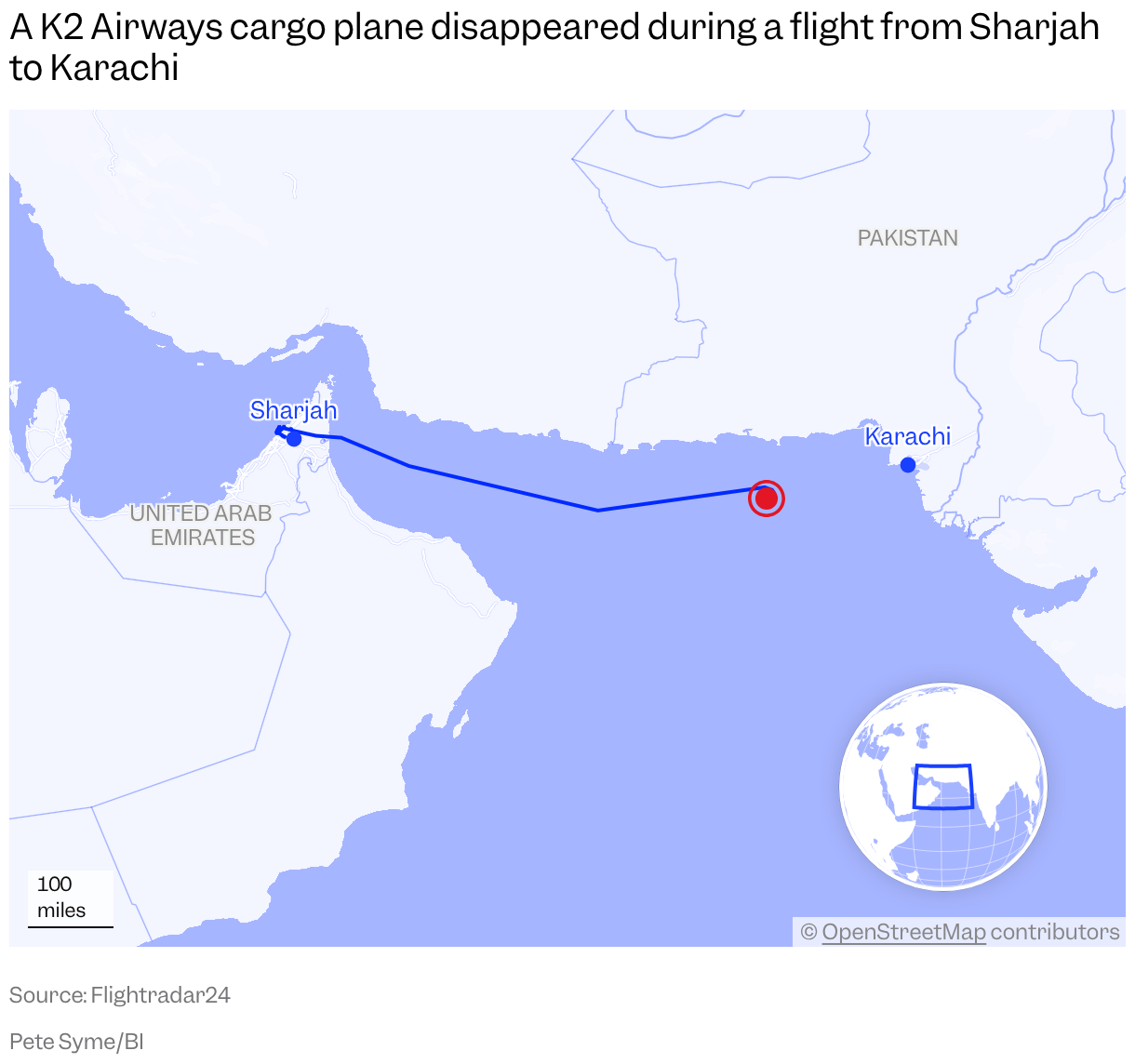
The 737's flight path crossed a tense region as the US and Iran have traded attacks despite a ceasefire, including US attacks on over 80 Iranian targets on Tuesday.
Past crashes have shown that maintenance failures can have catastrophic consequences: In 2000, Alaska Airlines Flight 261 crashed into the Pacific Ocean near California because of improper maintenance on the horizontal stabilizer, for example.
Stephens also said sabotage is possible, though difficult to prove. In 2015, a Germanwings pilot intentionally crashed a plane into the French Alps, killing all 150 people on board; investigators later found he had a history of depression and suicidal thoughts.
Anthony Brickhouse, an aviation safety analyst and consultant, said the dramatic changes in altitude were "concerning," and investigators will look for certain signatures in the wreckage to determine contributing factors.
"Everything is on the table until evidence says otherwise," Brickhouse said.
He added that the plane's velocity and angle of attack at impact with the water could affect the extent of fragmentation during recovery. Crashes at sea are typically harder to investigate because many critical components sink to the ocean floor, making them difficult to locate and recover.
For example, it took investigators five days to find the wreckage of Air France Flight 447 after it crashed into the Atlantic Ocean in 2009 and nearly two years to recover its black boxes. The Malaysia Airlines plane that infamously disappeared in 2014 has still not been found.
Brickhouse said the search for K2's aircraft was more straightforward because it was confined to a much smaller area and used better tracking technology.
The freighter was not a 737 Max variant
The Boeing 737 has been plagued by negative publicity in recent years, but Tuesday's crash is unlikely to be related to it.
The K2 plane, registered AP-BOI, first entered service in 1999 and carried passengers until 2011, when it was converted into a freighter.
It was not the Max variant with the faulty system that led to the 737 Max crashes in 2018 and 2019. The jet also had many operators from several different countries over its 27 years, who were responsible for the upkeep and maintenance. K2 started leasing it in 2024.
Pakistan Airports Authority
The accident is instead likely to draw added scrutiny to Pakistan's troubled aviation safety record.
The country has experienced several deadly crashes over the past two decades, including a 2020 accident in Karachi that killed nearly 100 people and prompted US authorities to ban Pakistani carriers from US skies. Europe similarly banned Pakistani aircraft but lifted that in 2025.
In 2019, a Pakistan Army military plane crashed into a city in the country's northern city of Rawalpindi, killing five crew members and 13 civilians on the ground. In 2010, an Airblue flight crashed north of the capital, Islamabad, killing more than 150 people on board.
K2 Airways said in a Facebook post that it was cooperating with government agencies for the investigation. It also shared the names of the five crew members.
According to its website, the 737 was the only airplane in its fleet.
In a statement on Friday, the Pakistan Airports Authority said that recovery efforts continue. Search-and-rescue teams are looking for crew members, and an investigation team has recovered additional aircraft parts for analysis.
Boeing and K2 Airways did not respond to requests for comment from Business Insider.
from All Content from Business Insider https://www.businessinsider.com/boeing-737-plane-disappeared-pakistan-2026-7
via gqrds


No comments:
Post a Comment
Note: Only a member of this blog may post a comment.